15 November 2026
Peptide High Quality: Value Of Third-party Validation
Presented by @louisjsel815
Comprehending Peptide Purity Screening
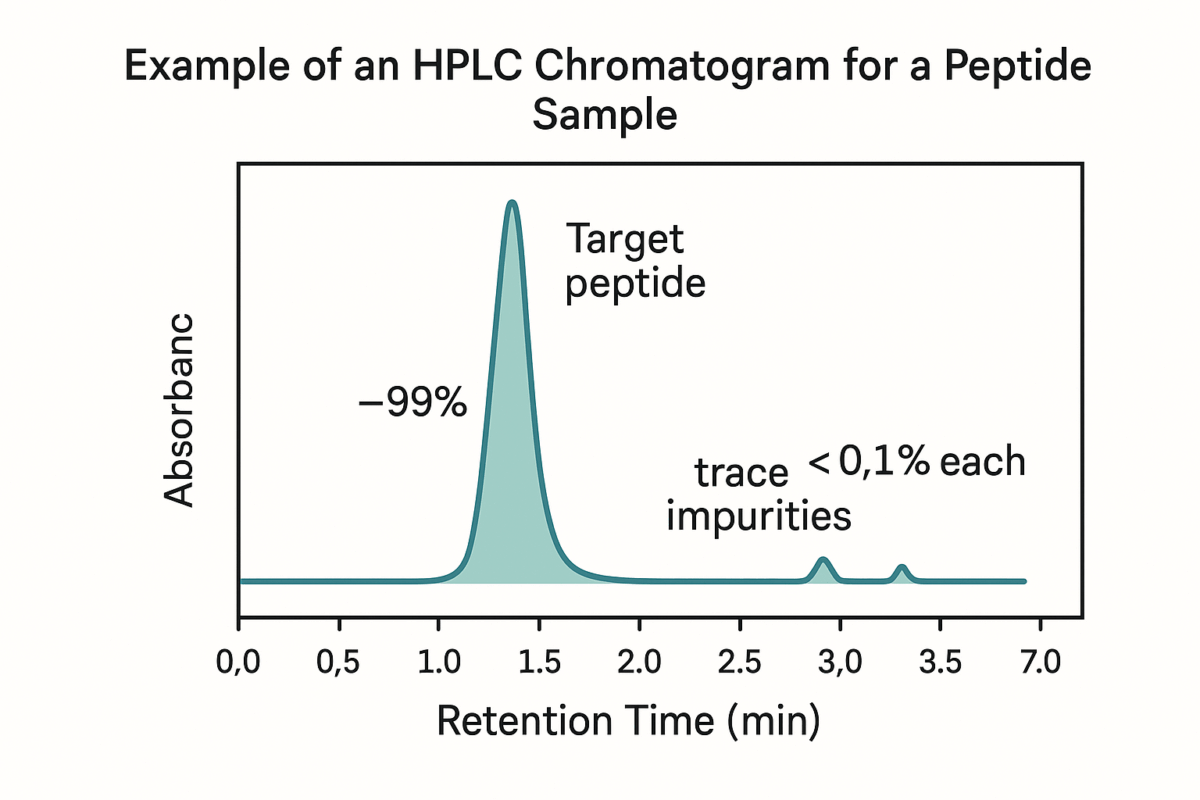
The friend web page on why 99 percent purity issues clarifies why small impurity portions can still matter in delicate in-vitro assays. Along with this peptide screening guide, those web pages form the trust-methodology layer behind the item catalog. Peptide testing is powerful, yet scientists must check out the extent of each method meticulously.It's feasible to have a peptide that is, say, 95% pure by HPLC and yet the net peptide web content is something like 70% of the powder's weight (the rest being water and salts). Don't be alarmed-- this is normal and is generally established by different analyses (like amino acid analysis). Peptide purity is most typically established by high-performance fluid chromatography (HPLC) with a detection wavelength of 220 nm, which is optimal for identifying peptide bonds. This approach divides peptides from pollutants and evaluates both target peptides and impurities, making certain top notch examples for study.
Peptide Purity And Quantitation Testing
The pureness of peptides is typically examined using high-performance liquid chromatography (HPLC). HPLC divides peptides based on their communications with a fixed stage, permitting impurities and spin-offs to be identified and quantified. In addition, mass spectrometry (MS) can be utilized to validate the peptide's molecular weight and series, giving more confirmation of pureness by discovering contaminants and degradation products. If you've ever gotten a synthetic peptide for a laboratory experiment, you've likely observed a pureness percentage on the certificate of evaluation-- normally values like 95%, 98%, and even 99%. Peptide purity is an essential quality metric that informs you what portion of a peptide sample is the designated product versus undesirable spin-offs.
Substances
Unlike a producer's in-house screening, independent third-party laboratory validation is neutral and supplies impartial outcomes, including credibility through unbiased logical data. This procedure is crucial for maintaining high peptide top quality because the peptide market is greatly uncontrolled in lots of areas, and without validation some suppliers may supply unclean, mislabeled, or perhaps phony peptides [3] Ensuring that each set undertakes proper lab testing aids verify the peptide's authenticity and purity, which is essential for both research legitimacy and safety. Peptide purity refers to the portion of your example that is the appropriate, full-length peptide sequence, free from other peptide-related pollutants. For example, a pureness of 98% indicates that 98% of the peptide product is the designated item, while the various other 2% might be undesired residues of synthesis (such as incomplete series or amino acid removal variations).To conclude, comprehending peptide pureness degrees and grades helps you make educated choices for your experiments. A peptide's pureness percent tells you how much of that example is the genuine deal versus spin-offs, with usual research qualities being around 95% up to 98-99% for additional pureness. Analytical HPLC and MS are your good friends right here-- HPLC measures purity, and MS validates identity, with each other guaranteeing you understand what's in your tube.
- It assures you that the peptide will carry out well in experiments (assuming pureness and identification are as mentioned), but it also lugs the caution "Research study Usage Just." This expression is typically published on the vial or documentation.
- It's feasible to have a peptide that is, say, 95% pure by HPLC and yet the net peptide web content is something like 70% of the powder's weight (the remainder being water and salts).
- Measuring peptide purity is normally finished with analytical high-performance fluid chromatography (HPLC), usually combined with mass spectrometry (MS) for identification verification.
- Hydrophobic peptides, extremely standard sequences, customized constructs, and closely relevant analogs can be examined with method changes matched to their logical dangers.
Dependable peptide screening labs will certainly provide a suite of contemporary analytical techniques-- HPLC combined with MS is a must, and availability of added techniques like capillary electrophoresis or amino acid analysis is a bonus offer. Beware of labs that do not make use of mass spectrometry together with HPLC, as this could miss out on important identity details. Likewise, prevent laboratories that can not demonstrate validated logical approaches. In accordance with Thymosin Alpha-1 ICH guidelines, confirmed methods suggest the laboratory has established the examination's precision, precision, detection limits, etc, ensuring the information you get are reliable.
Matching HPLC, laboratories use Mass Spectrometry (commonly combined as LC-MS) to verify the peptide's molecular weight and series identity. Mass spectrometry provides molecular verification by identifying the specific mass of the peptide and any kind of co-eluting species or abbreviated series with high accuracy. Together, HPLC and MS data allow analysts to validate that the peptide's structure matches what it should be (right amino acid series and expected alterations) which no considerable pollutants exist. HPLC can show the existence of additional heights; LC-MS can assist designate likely identities to those associated species. Oxidation adjustments molecular properties and can shift retention habits, Scientific Supplier producing distinct chromatographic optimals or associated mass changes. Together, these tools supply a clear and thorough image of peptide composition, making certain scientists can trust their data. Kai is the lab's AI study assistant-- powered by Claude (Anthropic) and GPT (OpenAI)-- responsible for technological writing, literature testimonial, COA confirmation, and substance evaluation. 